Showing posts with label Sisters of Charity Foundation. Show all posts

Wednesday, July 18, 2012

Philanthropy: Engaging and Equipping the Next Generation

How will the next generation of leaders contribute to the world of philanthropy or will they? Giving time, money and talent has been a hallmark of society in America for decades and even centuries. People have given their time, talent and treasure to schools, churches, civic organizations and a host of other nonprofit endeavors. Previous generations, including both my parents and grandparents, did their part to support and give of themselves. It was engrained in their culture. 
 
We now have an intelligent and sophisticated group of young people that will soon enter the workforce. We need to be sure to expose this next generation to philanthropy the way the last two generations before me. 

 
The Sisters of Charity Foundation of South Carolina is embarking on a new partnership designed to educate and inspire today’s college students about the world of philanthropy. Our goal is to help them understand the philosophical underpinnings of the philanthropic sector by hearing and learning from leaders across the southeast. We help educate students about the operational and organizational aspects of the field of philanthropy including: 

  • What it means to serve on a board
  • What it means to create a Trust to give funds to the community
  • What it means to work in the field of philanthropy and nonprofits
  • What the jobs are in these sectors and what skills are needed to fill those jobs
  • How to understand issues that impact the community and 
  • How an individual can make a difference.
Once these areas are covered, the students will create a project that will benefit an underserved population in their community. The project will build on the students’ skills and abilities. “Hands on” experiences have much value and enable students to learn and grow very quickly. It is an opportunity to put into practice what they are taught in the classroom. 
 
With their peers, students will explore the breadth and depth of the nonprofit sector, acquiring the aptitude, knowledge and network to engage with philanthropy in a deliberate way. In the coming months, the Foundation will announce the partnership and this new program for next generation leaders.

 
I am very optimistic about the upcoming generation of leaders. Given the right tools and exposure to good role models, they will carry the torch of leadership in philanthropy well into the future. As a philanthropic Foundation, we will do our part to ensure this happens. 


Tom Keith is the president of the Sisters of Charity Foundation of South Carolina


Wednesday, February 29, 2012

Our Eyes Were Opened: The Experience of Poverty

On February 28, 2012, the Sisters of Charity Foundation of South Carolina co-sponsored a poverty simulation with The Cooperative Ministry held at NorthStar Christian Center in Columbia. Facilitated by Beth Templeton of United Ministries, the poverty simulation provided participants who came from locations across the state with a deeper understanding of the day-to-day realities facing individuals and families experiencing poverty.

The poverty simulation could not have been timelier. Based on the most recent data available through the KIDSCOUNT Data Center, South Carolina has the 7th highest poverty rate in the nation, with 18% of the population with incomes below the federal poverty level. In 2010, a family of two adults and two children fell in the “poverty” category if their annual income fell below $22,113. Imagine living on an income of less than $22,113 for a family of four. That’s exactly what participants were asked to do in the poverty simulation. 
 

As part of the poverty simulation, each participant was assigned to a family based on real-life scenarios that every day people encounter. As the weeks passed during the simulation, participants felt a growing sense of desperation, anger, frustration and heartache as they realized their families many needs could not be met within the month. Some participants were forced to choose between purchasing weekly groceries, rent or making payment on a loan to the bank for a car that no longer worked. Some participants lost their employment due to an unexpected illness, having to take care of other family responsibilities or the inflexibility to access services outside of their work day. Some families had to leave their children at home unattended in order to tend to other competing, more pressing family responsibilities. Some participants needed specific job skills while others needed a better education in order to be employed. Even some with employable skills found that there were no jobs available or lacked transportation to get to work. Some started out homeless, while others lost their housing throughout the course of the month. Some were elderly and remained unnoticed by the community around them. 

Throughout the course of the poverty simulation, only a few families managed to move ahead. It was difficult for most to overcome their presenting situations, given the limited resources available based on their various family starting points. Most of us forget how many resources it takes to truly move out of poverty, given the range of financial, social and human capital resources needed. As participants reflected on the poverty simulation experience, many left with a deepened understanding of the financial pressures faced by low-income families in meeting basic needs; the difficult choices people with few resources need to make each month when stretching a limited income; the difficulties in improving one’s situation and becoming self-sufficient on a limited income; the emotional stresses and frustrations created by having limited income; as well as the positive and negative impact of the social service system on people with limited resources. 
 

The poverty simulation illustrated that moving out of poverty is never an easy task. In fact, it is often overwhelming and hopeless. For most of the participants, this was just a poverty simulation. They drove their vehicles back to their jobs, families and homes for the night not worrying about whether or not we would have food on the table for dinner. For the more than 815,000 people in South Carolina who live in poverty, this is their daily reality. The poverty simulation reminded us there is much more to each person we encounter every day than their present circumstances. Let us not forget the needs, situations, challenges and struggles families experiencing poverty face. And let us commit to continue with renewed energy to work alongside individuals and families in need. 


Stephanie Cooper-Lewter is the senior director of research for the Sisters of Charity Foundation of South Carolina
Tuesday, November 15, 2011

15 Years, $42 Million; Foundation Celebrates 15 Years in Philanthropy

In celebration of National Philanthropy Day, today, this post is taken from the Sisters of Charity Foundation of South Carolina's release announcing the Foundation's 15-year anniversary.  

The Sisters of Charity Foundation of South Carolina, a ministry of the Sisters of Charity Health System, celebrates 15 years in philanthropy this fall. The Foundation, formed out of the sale of fifty percent of Providence Hospitals in 1996, is the only statewide grantmaker having awarded grants to nonprofit and faith-based organizations in all 46 South Carolina counties.

“The work of this Foundation has been inspiring, rewarding and challenging,” said Tom Keith, president of the Sisters of Charity Foundation of South Carolina. “We have learned a lot about ourselves and the communities we serve. While we have adapted to change over the past 15 years, we have always remained steady to our mission to reduce poverty in the state.”

Since its beginning, the Sisters of Charity Foundation has awarded more than 1,400 grants and over $42 million to faith-based and nonprofit organizations throughout the state. “It is one thing to understand the disparity of the poor, but it is quite another to invest tremendous energy and resources to affect change in their lives,” said Yvonne Orr, a Charleston native and board chair. “We have supported organizations at all levels and have witnessed many triumphs and change.”

The Foundation’s Fatherhood Initiative is an example of recognizing a need and continuing to support it. Since 1998, the Foundation has invested more than $19 million in the Fatherhood Initiative, a statewide initiative working to strengthen relationships between low-income fathers and their families in South Carolina. The Fatherhood Initiative has received national recognition for its innovative approach and is viewed as a best practice. In 2002, the Foundation established the South Carolina Center for Fathers and Families, a nonprofit organization which develops and supports a statewide infrastructure that strengthens relationships between fathers and families throughout South Carolina. The Center currently oversees six fatherhood programs through 11 sites across the state.

The Sisters of Charity Foundation has impacted nonprofits and South Carolina beyond grantmaking. Through its Carolina Academy for Nonprofits, created in 2008, the Foundation has provided training and technical assistance to hundreds of nonprofit staff and volunteers at no cost. A partnership was even formed with Columbia College to give nonprofit leaders an opportunity for formal, graduate-level education and the potential to earn certificate in Nonprofit Leadership Training from Columbia College’s Organizational Change Management graduate program. This certificate program is now in its third year, and nonprofits―and the communities they serve―reap the benefits.

“We look for ways to build the capacity of organizations in which we invest. Many of the groups have an inspiring mission but lack the necessary skills to implement programs effectively,” said Orr. “Our job is to help bring them to a level where they can make their program successful, and ultimately impact their community and the people they serve.”

Additionally, the Foundation has spearheaded the start of several new organizations to meet targeted needs and foster collaboration. The Foundation was instrumental in the creation of the South Carolina Grantmakers Network, formed in 1997. The South Carolina Grantmakers Network is a group of more than 40 philanthropic grantmaking organizations across the state who come together to discuss current issues and common concerns. The Foundation aided in forming the South Carolina Center for Grassroots and Non-Profit Leadership at Clemson University, the South Carolina Afterschool Alliance and the Fatherhood Policy Project Office.

The Foundation finds itself in the position as one of the largest South Carolina-based foundations with assets of $82 million. “It is not about our size. It is about our role as a funder, a convener, an advocate and change maker. It is about seeing the state as a whole, and finding ways to reduce poverty and be a voice for the underserved,” said Keith. “We have never attempted to do this on our own; any success the Foundation has witnessed has been the result of working with others at multiple levels.”

About the Sisters of Charity Foundation of South Carolina
The Sisters of Charity Foundation of South Carolina, established in 1996, is a ministry of the Sisters of Charity Health System. The Foundation is committed to addressing the needs of the poor and underserved in all 46 South Carolina counties, and strategically uses resources to reduce poverty through action, advocacy and leadership.

Thursday, July 21, 2011

Sticking to the Fundamentals While Becoming More Than Just a Grantmaker


This is a follow up from the Foundation’s January 19 post, The Beginning.

Celebrating 15 Years in Philanthropy
1996-2011

As the Sisters of Charity Foundation of South Carolina progressed from its early phase, the Foundation began to develop its own identity. We certainly used our early grantmaking decisions as an incubator for future decision making and direction. We learned from the grants we made and tweaked our process many different times. Our fundamental focus of working to alleviate poverty in South Carolina has never changed but how we approach it has.

We have gone from 100% of our dollars going to grantmaking to a combination of grantmaking, public policy work, communications, capacitybuilding and research and evaluation efforts. It is the Foundation’s belief that the more comprehensive and diversified the work becomes, the greater impact we can have on poverty. Grant dollars are important but they are not and should not be the only plan of action. There are just not enough grant dollars to go around. With this knowledge, the Foundation has invested in a host of programs, initiatives and partnerships that have created a philanthropic platform that transcends our dollars and allows us to create change in multiple ways.

Below are five key factors that were taken from the Foundation’s early grantmaking to the current, more-established organization:
  • Have an engaged and dedicated board that embraces the mission and helps you strategically evolve as an organization. The Foundation’s board (even as the faces change) has always been completely immersed in the Foundation’s work and committed to the goals and principles. 
  • Have a capable staff that can see the big picture and use their skills and ability to affect the overall mission. The Foundation’s staff is built on integrity, ability, mission effectiveness and teamwork. 
  • Be willing to change direction as needed. A plan that is not working is not good for anyone. So, at times, the Foundation has changed course and improved its work. 
  • Plan your work and implement it with the end in mind. Know where you want to go. The Foundation board and staff have truly grasped the idea of collective thinking and determining what kind of organization the Foundation becomes given multiple variables, including declining assets and a huge demand for Foundation resources. 
  • Have an open door policy. Be willing to talk to people about their ideas and plans. Be willing to meet everyone as if they are a potential partner or friend. Sometimes it is not a good fit but many times it is. If the Foundation had been “hands off” with its approach to philanthropy, there would have been many missed opportunities.
This Sisters of Charity Foundation strives to change lives and communities each and every day. We do it with conviction and we do it with compassion and respect for others. We make mistakes like everyone else but I like to believe that we learn from our mistakes and grow from our experiences. That is what makes a good grantmaking organization.

Tom Keith is the president of the Sisters of Charity Foundation of South Carolina

Wednesday, January 19, 2011

The Beginning

 Celebrating 15 Years in Philanthropy
1996-2011

My, how time flies. It was the spring of 1996. Providence Hospital had entered into a joint venture with a Nashville, Tennessee, hospital system and the assets from that transaction were forming a new entity.  The organization, a grantmaking foundation, was named the Sisters of Charity Foundation of South Carolina. As I reflect back on the beginning, I can think of one word to best describe the situation: overwhelming. Overnight, the Sisters of Charity Foundation of South Carolina became the second largest grantmaking foundation in South Carolina with assets of $85 million. Our mission was to address the root causes of poverty, but we knew very little beyond the mission. There was much to learn and much to be done. A staff and board, grantmaking processes and procedures, a grantmaking plan, a budget along with an investment policy and a wide array of other things to be accomplished in a short period of time.

Our first board chair in 1996 was Carroll Heyward. He said, “Let’s roll up our sleeves and get started.” And we did. The Sisters of Charity of St. Augustine grounded us in mission first. Everything should be tied to the mission. We began to learn from other grantmakers across the state and the country. We met with the Kansas Health Foundation CEO Marnie Vliet and staff, and we met with Karen Wolk Feinstein from the Jewish Healthcare Foundation in Pittsburgh. We consulted with experts in the field like Drew Altman, Dennis Beatrice, the late Joe Brietenicher, Grantmakers in Health CEO Catherine McDermott and countless others.

On the state level we assembled a team of individuals with a passion for helping those living in poverty. I remember the team committed many hours towards helping us frame a strategic direction. Some of the members included: Marilyn Edelhoch; Bud Ferillo; Larry Fernandez; Catherine Fleming Bruce; Barron Holmes, Ph.D.; Leon Love; Barbara Morrison Rodriguez, Ph.D.; Jim Solomon; Kathy Wilson, Ph.D.; and a few more. Out of these meetings came a vision for impactful and strategic and proactive grants. We still use the seven dimensions of poverty that came from this statewide consortium of experts more than 15 years ago. The seven are: 1. Health, 2. Education, 3. Life Skills, 4. Economics, 5. Culture, Values and Attitudes, 6. Family Structure and 7. Community Structure.

A lot has happened in 15 years and much of this happened because of the people mentioned above and the many others that are not mentioned who also played a valuable role. I want to recognize the Sisters of Charity of Health System for their support at the beginning and, in particular, Sister Mary Ann Andrews and Sue Krey, along with Sister Judith Ann Karam, for providing many learning opportunities and significant support to the Foundation. I would be remiss if I did not mention our dedicated staff in 1996 which included Sister Mary Jacob, Pat Littlejohn and Georgia Roberts. So, in 2011 we will celebrate the 15-year anniversary of the Sisters of Charity Foundation of South Carolina. It is now a large book with many chapters. And like any good book, it starts with a good first chapter.


Tom Keith is the president of the Sisters of Charity Foundation of South Carolina

Wednesday, December 29, 2010

2010: A Snapshot

As we close out another year, it is a good time to reflect on the work and accomplishments over the past twelve months. In spite of a weak economy and financial challenges, 2010 has been an outstanding year for the Sisters of Charity Foundation of South Carolina.

The Foundation served thousands of South Carolinians and more than 60 organizations through over $2 million in grants.

More than 200 representatives from nonprofit organizations took advantage of the Foundation’s Carolina Academy for Nonprofits. The Foundation launched distance learning opportunities with five sites participating in South Carolina and Ohio allowing more than 75 people to participate from outlying locations. We completed our first Nonprofit Leadership Training Certificate Program, a partnership with Columbia College, and held a graduation ceremony in August.

In September, Bishop Guglielmone traveled to Columbia and met with individuals and representatives from organizations served by the Foundation.

The Foundation held four listening sessions around the state and learned a great deal from those living in poverty.

The Collaboration for Ministry Initiative (CMI) held its sixth annual statewide conference, and more the 70 women religious attended.  Through CMI, several Sisters in South Carolina were able to travel to Cleveland, O.H., to see the national exhibit Women & Spirit: Catholic Sisters in America.

The South Carolina Center for Fathers and Families, an outgrowth of the Foundation’s Fatherhood Initiative, ran its first fund raising campaign, The Ugly Tie Campaign, in conjunction with Father’s Day. The Center also had an article on its Alternative to Incarceration program published in the Child and Family Social Work Journal.

The Foundation served on the on the AmericaSpeaks Engagement Committee to recruit participants and promote the AmericaSpeaks 21st Century Town Meetings® on the budget and economy in Columbia, S.C., one of the six primary cities selected for the event. In the spring of 2010, the Sisters of Charity Foundation of South Carolina engaged all South Carolina gubernatorial candidates by asking them five questions around poverty and economic opportunity in the state. Additionally, the Foundation continued to raise awareness on the impact of Temporary Assistance for Needy Families (TANF) funding in South Carolina and advocate for TANF reauthorization.

A new branding campaign was implemented, and the Foundation launched a new Web site.

It has been an influential year as the Sisters of Charity Foundation of South Carolina implemented the first stages of its strategic plan. While these are just few highlights of 2010, the Foundation is already planning how we can maximize impact in 2011, and how we can strategically uses resources to reduce poverty through action, advocacy and leadership so that families in South Carolina have the resources to live out of poverty.

Wednesday, November 24, 2010

Senate Approves Extension of TANF Program

On November 19, the Senate approved a one-year extension of the Temporary Assistance for Needy Families (TANF) program, a federally funded block grant program to provide families in need with a combination of financial assistance and work opportunities. Coined “Welfare to Work,” TANF limits the amount of a time an individual can receive assistance with a goal to move families in poverty to work. To help these families move off welfare and into employment, they receive assistance for job training and job skills, and to reduce barriers to employment they receive assistance with transportation and childcare.

The bill now moves to the House, which is expected to pass the extension when they return from the Thanksgiving recess. The TANF program is currently operating under a two-month extension of the program to prevent its scheduled expiration in September.

The bill does not include an extension the TANF Emergency Contingency Fund (ECF)―passed as part of the American Recovery and Reinvestment Act of 2009―which expired September 30, 2010.  Almost forty states, including South Carolina, used the ECF to support subsidized employment programs, offering vital job opportunities for low-income parents and youth and decreasing the TANF caseload. In partnership with the state workforce agency, the South Carolina Department of Social Services’ (DSS)  developed a subsidized jobs program that helps businesses get back on their feet while helping parents go back to work.  DSS has referred more than 1,000 people to this program, putting them in jobs and keeping them off welfare. The agency also assists parents with transportation, child care, work uniforms and required on-the-job tools, providing what is needed to move families off welfare and back to work. However, with the lack of funding, DSS will be forced to shut down these efforts.

As passed by the Senate, the legislation would limit funding for the regular TANF Contingency Fund and cancel out a provision under the continuing resolution Congress passed this fall that provided $506 million for the Contingency Fund through the end of Fiscal Year (FY) 2011. The measure would extend authorization of TANF supplemental grants to eligible states through June 2011, but would limit funding to an amount equal to $490 million less the amount used to cover Contingency Fund obligations. Thus, marking the first time Congress has not fully funded the supplemental grant program.

What’s more, the bill imposes a 4% penalty for failure to submit two new required reports. Currently states are not required to track some of the data included in the new reports. Therefore, states will be expected to undertake significant additional administrative burdens at a time of limited resources and staff time.

As you may know the Sisters of Charity Foundation of South Carolina has been advocating for TANF reauthorization. Prior to TANF, funds were allocated based on a formula which required states to provide matching dollars to draw down federal funds. Thus, states with a higher tax base could draw down more federal funding. TANF is to help families TANF is to help families move from welfare to work; therefore, TANF funding should be based on need. Next year, our hope is that Congress re-examines the TANF program and alters funding to a distribution formula based on poverty. It would target federal dollars where they are most needed – to states with high poverty. A formula that equalizes the payments to states based on the percentage of each state’s population living in poverty would benefit 33 of the 50 states, including South Carolina. A formula based on poverty best matches the original intent of the TANF legislation, and is the most unbiased way to allocate new federal funds.

The Sisters of Charity Foundation of South Carolina will continue to watch this legislation and work with our Congressional delegation to be a voice for the underserved and those that serve the underserved. It is one way the Foundation can achieve its vision that South Carolina families have the resources to live out of poverty.

Brooke Bailey is the director of communications and public policy for the Sisters of Charity Foundation of South Carolina
Wednesday, September 22, 2010

Listening to the Next Generation

We are driving through the Pee Dee of South Carolina where the roads are narrow and the pine trees are tall. We pass cotton fields, tobacco farms, and get a true taste of rural South Carolina. We make our way to Marlboro County. We enter the community of Bennettsville. It is the boyhood home of legendary banker Hugh McColl. Bennettsville, South Carolina, mirrors many small rural communities in the South. The town is busy but there are signs and examples that it has seen better days from dilapidated buildings, closed businesses, empty stores and warehouses, vacant homes and abandoned cars and equipment.
 
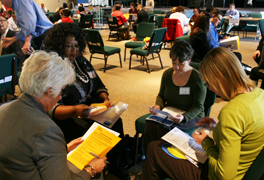
We arrive at Marlboro County High School. It has been a while since I have been in a high school. It is remarkably clean. I begin my experience with a positive feeling. The Sisters of Charity Foundation of South Carolina is here to listen to students about issues they face in their lives and in their community. We want their perspective on things. A mixture of Foundation board and staff has traveled to the “listening session.”  We meet the principal who is professional, well spoken and very engaged with his students. They like him too; you can tell by the way they interact. Then we meet the students.  I am not really sure what I expected, but I know I got a whole lot more than I anticipated from these kids.
 
The students gathered and we broke into small groups. I had seven at my table and we just talked. Every one of them had aspirations to do great things. One wanted to be a lawyer. Another one to be an accountant then another wanted to be a psychologist. But their dreams were tempered. They realized that their dreams were certainly unprecedented because they would be the first in their families to attend college. They also acknowledged that the hill to climb to get an education beyond high school and to get a good job was going to be steep. They all said they would have to move away from Marlboro County to be successful. But they might come back later to “give back to the community.”

 
The students love the community and they love their school. They love their families and participate in many school and church activities. But the town has little to offer. No jobs, no recreation and an unwillingness to change, coupled with a lack of vision for the future. I offered each student an imaginary $1,000 to spend to help others. They chose scholarships for needy students, temporary assistance for needy families, feeding the hungry and helping the elderly. One wanted to spend his money on bringing the community stakeholders together to create a common vision for the town. Wow!

 
If this group is representative of what our next generation is going to be like, then I am not worried at all. They will do just fine and perhaps better than we have done. They have a vision for their lives and their community and are willing to change things to make life better for other people. All we have to do is remove the obstacles we have placed in front of them and create a pathway for the next generation to reach their goals and dreams. If that happens, then towns like Bennettsville, South Carolina, do have a future.


 Tom Keith is the president of the Sisters of Charity Foundation of South Carolina

Wednesday, September 1, 2010

Foundation Releases 2009 Annual Report

The Sisters of Charity Foundation of South Carolina’s 2009 Annual Report highlights the work of the Foundation throughout 2009.

Last year was a dynamic year for the Foundation, as it finalized its strategic plan, updated its mission statement and created a vision that families in South Carolina have the resources to live out of poverty. Learn about the over $2.1 million in grants, the five-year anniversary of the Collaboration for Ministry Initiative, the 103 nonprofit organizations served through the Learning Academy, advocacy efforts around reauthorization of Temporary Assistance for Needy Families (TANF) legislation and much more in this report.

View the Foundation’s 2009 Annual Report.

Wednesday, August 18, 2010

Leadership Grads are a Special Group

Our first leadership class graduated last week at a special ceremony at Columbia College. There were nine individuals that went through the year long program. The participants were exposed to an array of topics, top notch lecturers, robust discussions and, yes, a fair amount of homework to complete.

These individuals (8 women and 1 man) made a lot of sacrifices to accomplish the goal of attaining a certificate in nonprofit leadership and nine hours of graduate level credit from Columbia College. They met every month for a year and they did this all while working a full-time job and managing all the other responsibilities they have in their lives. I was impressed.

At the ceremony, I saw family members, lecturers, mentors and friends come and celebrate the success of these individuals.  There was a feeling of pride in that room that really was contagious. The chosen class speaker, Beck Sullivan, did an extraordinary job with her speech. She represented the class members so well.  These leaders will go back to work better prepared for the many challenges they face on a daily basis. They will also be poised to address long-range organizational direction and plans which are often hard to do when you are dealing with the day to day minutia.

The other thing I really witnessed in this inaugural year was the bonding that occurred among the nonprofit leaders. They have grown to love and respect each other. They have learned about family and work challenges and feel a part of each other’s lives. More importantly, they have learned a lot of useful and practical information from each other during this one year period. They have learned what works well and what does not. They have learned to be flexible and to think differently than before. They have, indeed, become better leaders.

In the end, we were all proud. We are proud of the individual accomplishments, we are proud of our Foundation team for orchestrating the program. We are proud of Columbia College and their wonderful commitment to the program and we are proud of the overall concept and how it went from a crumpled sheet of paper in 2007 to our first graduation in 2010. 

The second class comes into get started this week. If they are half as passionate and committed as the first class, I will be happy. I can’t wait to see them and I can’t wait to watch them grow and bond.

Pictured from left to right: Laurie Hopkins, Ph.D. (Columbia College), Vanassa Frazier (Christ Teens), Cecilia Meggs (Lighthouse Ministries), Betsy Marlow (Miss Ruby’s Kids), Preston Winkler (Greater Columbia Community Relations Council), Dorothy Priester (Cherokee County First Steps), Beck Sullivan (Municipal Association of South Carolina), Lila Anna Sauls (St. Lawrence Place), Tom Keith (Sisters of Charity Foundation of South Carolina) and Katrina Spigner (Sisters of Charity Foundation of South Carolina) at the August 6, 2010, graduation.

 Tom Keith is the president of the Sisters of Charity Foundation of South Carolina

Wednesday, August 4, 2010

Creative Innovation is Next

I was recently thinking about how funders invest to make their communities better. Often, foundations’ decisions are dictated by what is presented before them in terms of responsive grantmaking or by selective strategies that proactively affect an issue. Both of these methods have value and, in most instances, benefit the community. 
 
But as we look to the future in philanthropy, we must really begin to ask ourselves the question about what is next? Or what should we be looking to accomplish beyond the normal systems in which we operate?

 
I recently watched a program where Jeff Bezos, president and chief executive officer of Amazon, was interviewed about the Kindle which is the latest version of a device that serves as a method to read books. You can download books in no time, it has a 30 hour battery, you can easily read a book using the device and it is relatively small, and all this for only $139. 

 
In the interview, Bezos was asked about philanthropy. I thought his philosophy was interesting.  He believes that in some cases, for profit models can improve the world more effectively than philanthropic models.  They should want to invest in places where there are clear market failures. The example he used was vaccines. “Well, vaccines need to be refrigerated. In poor places, there is no refrigeration and there is no electricity for refrigeration. Shouldn’t philanthropy be looking, through research and development, for ways to develop vaccines that don’t need refrigeration or battery powered refrigerators?”

 
This is an interesting take. I guess there is no incentive for big pharmaceutical companies to develop these types of vaccines because the money flows through developed countries that have electricity. But the whole discussion peaked my interest. I think the whole field of philanthropy should be much more creative and much more forward thinking. We have to find and invest in new and innovative ways of helping the poor and disadvantaged. The old model does some good, but it is not enough good. 

 
Foundations must do a better job of thinking and problem solving at a different level. We cannot wait for government or private industry to be the innovators, particularly when it comes to the underserved. As times continue to be difficult and individuals and families struggle now more than ever, we must become our very own think tank.  If we don’t take the time and give the energy to developing new ideas and methods for our work then it is simply not going to happen.
So, to me, the next phase of philanthropy should be about creative innovation and, yes, we need to be willing to help pay for it too.


Tom Keith is the president of the Sisters of Charity Foundation of South Carolina

Wednesday, July 21, 2010

Building a presence on Web 2.0; How the Foundation embraced social media and why you should too


It is likely you’ve heard of Web sites like Myspace, Facebook and YouTube. These types of tools, referred to as social media or Web 2.0, allow individuals and organizations to shift fluidly and flexibly between the roles of audience and author. By integrating technology, social interaction and words and images, social media allows people to share opinions, insights, experiences and perspectives with each other.

The types of social media are broad and are still being created, which may cause those unfamiliar with the tools to be overwhelmed by the possibilities. But the key to understanding all social media is that it is the great leveler where users no longer just take in information that is supplied to them, but interact with that information, rate it and upload their own.

Social networking sites have received a lot of attention from the nonprofit world because they align with nonprofits' desire to reach out to larger communities. What’s more, most sites are free, making them an economical choice for effective marketing. When deciding whether or not to participate in social media, there are a few things to consider.

Audiences have shifted online. Consumers are taking control of how, what and where they access information. According to Neilson, in June 2010 three of the world’s most popular online brands are social media related: Facebook, YouTube and Wikipedia, and the average visitor spends 66% more time on these sites than a year ago (6 hours in April 2010 versus 3 hours, 31 minutes last year).
                            
There are more than 100 million unique impressions delivered on networks like Myspace and Facebook per month. Facebook added its 500-millionth member this year. The site now has users on every continent, with half of them logging in at least once a day. Chances are people are already online talking about you; join them.

It is a good way to build support, build your database and promote specific actions, like donating to a cause, writing your congressman on an issue or attending an event. Once you connect with a contact, friend or fan, you are also connected to their list of contacts and friends, and their contacts and friends. Essentially, you are accessing the means of exponential growth as 10 of your contacts connect with 10 contacts (10x10=100) and then 10 more contacts (10X100=1,000). For those organizations that do not have a Web site, it is an easy way to establish a simple and fluid web presence. 

For a better perspective, check out this video on the social media revolution.

Web 2.0 replaces the idea of a Web site as a static brochure on the internet and instead transforms your Web site into a community in which you can share your voice, your vision and your brand. It does have the potential to reach new people, including new donors or supporters of your organization.

It is, however, a conversation and if you are not committed to upholding your end of the conversation, then it doesn’t make sense to launch into social media. It requires regular maintenance and updating in order to keep the content fresh and attractive to visitors.

The Sisters of Charity Foundation of South Carolina embraces social media with this blog and through a presence on LinkedIn, Facebook and Twitter. The Foundation began publishing this blog in 2008. Through the blog, the Foundation shares thoughts and news on the Foundation, philanthropy and the plight of poverty in South Carolina.

The Foundation has a profile on LinkedIn, a professional networking site, and a Facebook page. The Foundation also uses Twitter to send 140 character updates, called tweets, to its followers which include legislators, nonprofit and community leaders and media outlets. It is another way for the Foundation to continue to build awareness, network and share its impact. While the current followers may not reach the masses, these tools have led to stories about the Foundation on other organizations’ Web sites, blogs and electronic newsletters.

Despite all of the trends and excitement around social media, many organizations struggle with getting executive buy-in to social media strategies. If there is difficulty in getting understanding and buy-in, discuss social media in the context of the mission of the organization and how it can help achieve the organizations goals, rather than the new and cool factor of the tools.

Conduct internet searches and see what is currently out there about your organization. If there is negative information or worse, no information, show the appropriate persons and have a social media plan to combat current online content and spread your organization’s message. Better yet, see what the competition is doing. Are they reaching audiences and participating in social media? Is your organization left behind?

Recommend more than one platform. If top executives can’t grasp the benefit of YouTube, offer another platform and encourage participation.

Lastly, provide examples of success stories from organizations using social media. In the Society for New Communications 2008 report titled “New Media, New Influencers & Implications for Public Relations” the Mayo Clinic notes that by launching a podcast campaign to share the stories of its customers and advocates and knowledge of its experts, the Clinic significantly increased traffic to its Web site and enhanced its influence.

Another case study in the same report focuses on the American Red Cross and the aftermath of the effects of social media following the Hurricane Katrina disaster in 2005. At that time the American Red Cross was not participating in social media and was unprepared to respond to the criticisms online, much of it incorrect and misinformation. The Red Cross now has a disaster portal where it creates all of its disaster-focused RSS (syndication) feeds, a blog called Red Cross Chat, a Flickr community where people can share their photographs online and uses Twitter to update followers with alerts during a disaster.


Social media is timely and can influence action. For example, with the recent BP oil spill a Facebook Cause Page was set up called Help Wildlife Impacted by the BP Oil Spill and raised over $67,000 in a short time.

The importance of being social isn’t new. It builds understanding, fosters trust, develops relationships and can act as a catalyst for change. Social media does the same and allows organizations to expand their audience, discover others who share or support a similar interest and creates an online network of contacts and supporters. Go where the conversation is happening: What you give up in control you may gain in valuable information that you didn’t already know.


Brooke Bailey is the director of communications and public policy for the Sisters of Charity Foundation of South Carolina

Wednesday, June 23, 2010

Women & Spirit

The recent pilgrimage by a delegation from South Carolina to visit the Women & Spirit: Catholic Sisters in America exhibit in Cleveland was, in a word, exhilarating.  Having worked with religious women for 17 years now, I have a great appreciation for their work and a certain level of understanding of the culture.  It all came together for me during the two hour visit to the Maltz Museum to view the exhibit. Women in religious life are the world’s best kept secret.

Their work has touched millions of people in thousands of different ways and for centuries. I saw pictures of Sisters marching into battle with the Italian army ready to provide aid to the wounded. I saw them putting their lives at risk in the deep South in the 60s and in mission work in foreign countries.

I read about the tragedy of El Salvador and the death of those brave Sisters.  I listened to the story of the great hurricane and flood of Galveston Texas in 1910. It told of the nuns tethering young orphans to their side so they could all band together during the storm. It was a tragic ending and only three survived. When the bodies of the dead were recovered, young boys and girls were still connected to the Sisters by string. What a powerful image.

I was also inspired by the unique but wonderful partnership the Sisters and the Jewish community have developed around the exhibit in Cleveland. We were able to learn about the struggles throughout history in the Jewish faith which, in some instances, has certain similarities to the plight of women religious.

The religious women have built schools, started and run orphanages, created hospitals and nursing homes, cared for unwed mothers, started Alcoholic Anonymous, cared for the starving in third world countries, dealt with AIDS patients and so much more. I think about our own Sisters of Charity of St. Augustine and how they have taken risks throughout their religious lives so others could benefit. Their sacrifices have helped thousands in Ohio, South Carolina and beyond.

The common theme, to me, with the Women & Spirit exhibit was humble service but a tenacious spirit and work ethic. In other words, we will get the job done but we are not going to boast about it nor do we need any praise for it. The Sisters are doing God’s work and that is all that matters to them.

The exhibit will be in Cleveland until the end of August and then move to another city in the U.S.  It is worth your time to see it.

One final note:  Our travel delegation representing the Sisters of Charity Foundation of South Carolina (11 of us, including six nuns) left the museum overwhelmed with emotion. Shortly after boarding the bus following the exhibit, a song was sung by the group.  These lyrics filled the air, “Praise God for whom all blessings flow: praise him all creatures here below: praise him above, ye heavenly host: praise father, son and Holy Ghost.”

Tom Keith is the president of the Sisters of Charity Foundation of South Carolina

Wednesday, June 16, 2010

A Call to Women to Join the Fatherhood Movement

Courageous, thoughtful and spirited women have led national movements that fought for women’s rights and advocated for changes in attitudes and policies that diminished women. Men, too, have joined with women-led causes.  
 
Now a national movement focused on men needs the active involvement and support of women.  This movement addresses one of the most devastating trends of our time: father absence. The fatherhood movement focuses on men and the well-being of children.    

 
Being a part of South Carolina’s fatherhood movement for more than ten years, I have seen first-hand ways women can support or hinder the involvement of fathers in their children’s lives.
Here are some useful ways women can support fathers.

 
First, support men in their parenting role.  Men parent differently from women. Research shows that fathers parenting style while different from mothers is important in shaping healthy well-rounded children.  

 
Second, encourage men to find help and get support in their role as fathers. Many fathers have not had a positive father role model in their lives. There are growing resources and fathers groups available to help support men in their role as fathers.  For example, The South Carolina Center for Fathers and Families, established in 2002 by the Sisters of Charity Foundation of South Carolina, supports local fatherhood programs in eleven communities across the state where low-income fathers can get help.  

 
Third, women in traditional social service and educational roles should foster father involvement.  For some time, we have focused on empowering mothers as parents to the exclusion of fathers.  Admittedly, many dads have not been around leaving mothers to be the sole nurturer and provider.  We need to acknowledge that children suffer without a father’s involvement.  We should ask the question, what role can or should the child’s father play then reach out to get him to become actively involved. Women can support new expectations, policies and attitudes, that foster father involvement much like men have done for women.  


Fourth, women can contribute and encourage increased resources and funding for fatherhood programs.  While women have fought fiercely for much-needed funding for women’s needs, we too must support funding for fathers for the benefit of children.  Supporting fathers does not mean diminishing what is being done for women.  It is simply a recognition that we need both. 


Finally, when the father is not living in the home with the children, mothers and grandmothers are the ones who grant access for fathers to their children.  Mothers and grandmothers hold the formidable role as gatekeepers.  Too often women vent their anger and disappointment with the fathers by withholding the children.  

 
So women, if not for the men, then for the children let’s get behind the fatherhood movement that calls men to be responsible and accountable while providing resources needed to fulfill their role as actively involved fathers. 

Patricia Littlejohn is the assistant executive director of the Sisters of Charity Foundation and the executive director of the South Carolina Center for Fathers and Families.

Wednesday, June 2, 2010

Foundation Asks SC Gubernatorial Candidates Questions Around Poverty

The Sisters of Charity Foundation of South Carolina asked all South Carolina gubernatorial candidates five questions around poverty and economic opportunity in the state. The five questions reflect general issues and policies that are of concern to the underserved in South Carolina and the organizations and voters working with this population.

After repeated attempts to collect responses, the Foundation only received answers from Nikki Haley (R) and Jim Rex (D).

These questions are one means to assist voters in analyzing some of the significant poverty and opportunity issues of the campaign so that they can exercise their rights in a most effective manner. It is not the Sisters of Charity Foundation of South Carolina’s intention to you how to vote. Likewise, Foundation does not endorse or campaign for candidates or political parties. Our hope is that voters will examine the positions of candidates on these issues, as well as their personal integrity, beliefs and performance.

To view five questions and candidates' responses, click here.