Showing posts with label South Carolina. Show all posts

Tuesday, October 9, 2012

2012 Presidential Election: Tracking the Candidates on Poverty

More people are living in poverty now than ever before, at least since records were kept. According to the U.S. Census Bureau, more than 46 million Americans were living in poverty in 2011, which for a family of four means an annual income of less than $22,100 a year. All this, and in four weeks citizens across the country will hit the polls to vote in the 2012 presidential election. Incumbent President Barack Obama is running for a second and final term during this election. His major challenger is former Massachusetts Governor, Republican Mitt Romney.
 

Released in January, Poverty, the Media and Election 2012: What Do Voters Think?, reveals the results of a survey of likely voters’ views on poverty and opportunity in the context of the 2012 presidential campaign. The report provides a snapshot of opinions provided by the survey, as well as by other public opinion polls on similar topics. Within this context, the report discussed five key findings in particular:
  1. Voters strongly said candidates’ views on poverty are important in deciding their vote for president. 
  2. Nearly half of voters said they have not heard enough from presidential candidates about reducing poverty.
  3. Half of voters said they have not heard enough from the media about reducing poverty during the presidential campaign.  
  4. Voters strongly said candidates’ positions on equal opportunity for children of all races are important in deciding their vote for president.  
  5. Voters tended to say children of all races do not currently have equal access to opportunity.
While poverty may not be a significant electoral issue, the findings in this poll suggested that voters are interested in hearing more about poverty and equal opportunity from candidates and the media, and that poverty and opportunity may play a role in their vote.
 

This was welcomed news to the Sisters of Charity Foundation of South Carolina which serves as an advocate for the poor and underserved in South Carolina. Educating and serving as a resource for both the community and public policy makers on issues affecting the poor is one way the Foundation engages in the public policy process. As we approach the November election, it is important to know the candidates’ views on poverty issues.
 
There is one organization tracking and sharing this information. Over the past few months, Spotlight on Poverty and Opportunity was tracking all candidates on poverty-related issues, from quotes to policy statements to media interaction. It is now covering the official nominees from the Democratic and Republican parties, Obama and Romney. Spotlight on Poverty and Opportunity is a non-partisan initiative that brings together diverse perspectives from the political, policy, advocacy and foundation communities to find solutions to reduce poverty in America.


Tuesday, November 6, 2012, marks the conclusion of the 57th presidential race with voters heading to the polls to cast their vote for the next president. Before you visit the polls, find out where each candidate stands on issues of both poverty and economic opportunity.

Please note that the Sisters of Charity Foundation of South Carolina does not support or oppose any candidate for public office. This resource is one means to assist voters in analyzing some of the significant poverty and opportunity issues of the campaign so that they can exercise their rights in a most effective manner.

Brooke Bailey is the senior director of communications

Wednesday, July 18, 2012

Philanthropy: Engaging and Equipping the Next Generation

How will the next generation of leaders contribute to the world of philanthropy or will they? Giving time, money and talent has been a hallmark of society in America for decades and even centuries. People have given their time, talent and treasure to schools, churches, civic organizations and a host of other nonprofit endeavors. Previous generations, including both my parents and grandparents, did their part to support and give of themselves. It was engrained in their culture. 
 
We now have an intelligent and sophisticated group of young people that will soon enter the workforce. We need to be sure to expose this next generation to philanthropy the way the last two generations before me. 

 
The Sisters of Charity Foundation of South Carolina is embarking on a new partnership designed to educate and inspire today’s college students about the world of philanthropy. Our goal is to help them understand the philosophical underpinnings of the philanthropic sector by hearing and learning from leaders across the southeast. We help educate students about the operational and organizational aspects of the field of philanthropy including: 

  • What it means to serve on a board
  • What it means to create a Trust to give funds to the community
  • What it means to work in the field of philanthropy and nonprofits
  • What the jobs are in these sectors and what skills are needed to fill those jobs
  • How to understand issues that impact the community and 
  • How an individual can make a difference.
Once these areas are covered, the students will create a project that will benefit an underserved population in their community. The project will build on the students’ skills and abilities. “Hands on” experiences have much value and enable students to learn and grow very quickly. It is an opportunity to put into practice what they are taught in the classroom. 
 
With their peers, students will explore the breadth and depth of the nonprofit sector, acquiring the aptitude, knowledge and network to engage with philanthropy in a deliberate way. In the coming months, the Foundation will announce the partnership and this new program for next generation leaders.

 
I am very optimistic about the upcoming generation of leaders. Given the right tools and exposure to good role models, they will carry the torch of leadership in philanthropy well into the future. As a philanthropic Foundation, we will do our part to ensure this happens. 


Tom Keith is the president of the Sisters of Charity Foundation of South Carolina


Wednesday, February 29, 2012

Our Eyes Were Opened: The Experience of Poverty

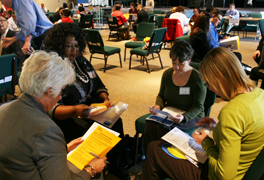
On February 28, 2012, the Sisters of Charity Foundation of South Carolina co-sponsored a poverty simulation with The Cooperative Ministry held at NorthStar Christian Center in Columbia. Facilitated by Beth Templeton of United Ministries, the poverty simulation provided participants who came from locations across the state with a deeper understanding of the day-to-day realities facing individuals and families experiencing poverty.

The poverty simulation could not have been timelier. Based on the most recent data available through the KIDSCOUNT Data Center, South Carolina has the 7th highest poverty rate in the nation, with 18% of the population with incomes below the federal poverty level. In 2010, a family of two adults and two children fell in the “poverty” category if their annual income fell below $22,113. Imagine living on an income of less than $22,113 for a family of four. That’s exactly what participants were asked to do in the poverty simulation. 
 

As part of the poverty simulation, each participant was assigned to a family based on real-life scenarios that every day people encounter. As the weeks passed during the simulation, participants felt a growing sense of desperation, anger, frustration and heartache as they realized their families many needs could not be met within the month. Some participants were forced to choose between purchasing weekly groceries, rent or making payment on a loan to the bank for a car that no longer worked. Some participants lost their employment due to an unexpected illness, having to take care of other family responsibilities or the inflexibility to access services outside of their work day. Some families had to leave their children at home unattended in order to tend to other competing, more pressing family responsibilities. Some participants needed specific job skills while others needed a better education in order to be employed. Even some with employable skills found that there were no jobs available or lacked transportation to get to work. Some started out homeless, while others lost their housing throughout the course of the month. Some were elderly and remained unnoticed by the community around them. 

Throughout the course of the poverty simulation, only a few families managed to move ahead. It was difficult for most to overcome their presenting situations, given the limited resources available based on their various family starting points. Most of us forget how many resources it takes to truly move out of poverty, given the range of financial, social and human capital resources needed. As participants reflected on the poverty simulation experience, many left with a deepened understanding of the financial pressures faced by low-income families in meeting basic needs; the difficult choices people with few resources need to make each month when stretching a limited income; the difficulties in improving one’s situation and becoming self-sufficient on a limited income; the emotional stresses and frustrations created by having limited income; as well as the positive and negative impact of the social service system on people with limited resources. 
 

The poverty simulation illustrated that moving out of poverty is never an easy task. In fact, it is often overwhelming and hopeless. For most of the participants, this was just a poverty simulation. They drove their vehicles back to their jobs, families and homes for the night not worrying about whether or not we would have food on the table for dinner. For the more than 815,000 people in South Carolina who live in poverty, this is their daily reality. The poverty simulation reminded us there is much more to each person we encounter every day than their present circumstances. Let us not forget the needs, situations, challenges and struggles families experiencing poverty face. And let us commit to continue with renewed energy to work alongside individuals and families in need. 


Stephanie Cooper-Lewter is the senior director of research for the Sisters of Charity Foundation of South Carolina

Wednesday, November 17, 2010

Immigration Reform

The debate on immigration reform remains a very hot topic. It continues in Washington and is also part of the discussion in South Carolina. States like Arizona have passed their own immigration laws because of the stalemate in Washington. The U.S. Government must step forward with real immigration law reform before more states follow Arizona’s lead.  The President has given it a high priority but, without bi-partisan support, it is unlikely that legislation will be passed.

The current immigration law in the U.S. is nothing short of confusing and outdated.  We are essentially patched together using pieces of the Immigration and Nationality Act of 1952. It is long past time to create a new law. 

According to the Immigration Policy Center, there are more than 180,000 undocumented immigrants in South Carolina.  This makes up about 4.4% of our state’s population.  Before determining what immigration reform needs to look like, let’s glance at some the economic data. Latinos (both foreign born and native born) wield nearly $3.8 billion in purchasing power in South Carolina. The Asian population makes up over $2 billion in purchasing power.  In the state of South Carolina, there are more than 3,000 Latino-owned businesses which employs more than 7,000 people and has annual sales in excess of $690 million. Many undocumented workers make up the workforce in agriculture, construction, housekeeping, restaurant and landscaping services to name a few. If all unauthorized immigrants left South Carolina, the state would lose more than $2 billion in economic activity, $782 million in gross state product and more than 12,000 jobs.

There is no denying that the immigration debate is complicated and divisive. Many children of immigrants were born here. Some immigrant children were brought here at a young age and know no other country. The vast majority of immigrants are contributing to their community with a strong work ethic and family values.

The answer to immigration reform is not to stop everyone on the street, ask for their papers, and if they are undocumented, ship them back to their home country.  First and foremost, it would be inhumane. Secondly, the cost would be exorbitant with no real way to pay for it, leading to an increase in our already skyrocketing debt. It is just not pragmatic. I am not suggesting that we open our borders and let everyone that wants to live in the United States enter freely. We have over 11 million immigrants without citizenship living in America now.  The Dream Act that was introduced by Senator Orrin Hatch is a good step forward. It allows young people who meet certain requirements to get an education and develop a pathway to citizenship.

True Immigration Reform will require compromise, practical thinking, fiscal responsibility and compassion. This country was founded by immigrants. That is how our forefathers got here in the first place. There are no easy answers but there is a way to make reasonable and thoughtful decisions in a bi-partisan manner. If we can have that kind of commitment to Immigration Reform, then we have a chance to do something meaningful and fix a broken system.

Tom Keith is the president of the Sisters of Charity Foundation of South Carolina

Wednesday, June 23, 2010

Women & Spirit

The recent pilgrimage by a delegation from South Carolina to visit the Women & Spirit: Catholic Sisters in America exhibit in Cleveland was, in a word, exhilarating.  Having worked with religious women for 17 years now, I have a great appreciation for their work and a certain level of understanding of the culture.  It all came together for me during the two hour visit to the Maltz Museum to view the exhibit. Women in religious life are the world’s best kept secret.

Their work has touched millions of people in thousands of different ways and for centuries. I saw pictures of Sisters marching into battle with the Italian army ready to provide aid to the wounded. I saw them putting their lives at risk in the deep South in the 60s and in mission work in foreign countries.

I read about the tragedy of El Salvador and the death of those brave Sisters.  I listened to the story of the great hurricane and flood of Galveston Texas in 1910. It told of the nuns tethering young orphans to their side so they could all band together during the storm. It was a tragic ending and only three survived. When the bodies of the dead were recovered, young boys and girls were still connected to the Sisters by string. What a powerful image.

I was also inspired by the unique but wonderful partnership the Sisters and the Jewish community have developed around the exhibit in Cleveland. We were able to learn about the struggles throughout history in the Jewish faith which, in some instances, has certain similarities to the plight of women religious.

The religious women have built schools, started and run orphanages, created hospitals and nursing homes, cared for unwed mothers, started Alcoholic Anonymous, cared for the starving in third world countries, dealt with AIDS patients and so much more. I think about our own Sisters of Charity of St. Augustine and how they have taken risks throughout their religious lives so others could benefit. Their sacrifices have helped thousands in Ohio, South Carolina and beyond.

The common theme, to me, with the Women & Spirit exhibit was humble service but a tenacious spirit and work ethic. In other words, we will get the job done but we are not going to boast about it nor do we need any praise for it. The Sisters are doing God’s work and that is all that matters to them.

The exhibit will be in Cleveland until the end of August and then move to another city in the U.S.  It is worth your time to see it.

One final note:  Our travel delegation representing the Sisters of Charity Foundation of South Carolina (11 of us, including six nuns) left the museum overwhelmed with emotion. Shortly after boarding the bus following the exhibit, a song was sung by the group.  These lyrics filled the air, “Praise God for whom all blessings flow: praise him all creatures here below: praise him above, ye heavenly host: praise father, son and Holy Ghost.”

Tom Keith is the president of the Sisters of Charity Foundation of South Carolina

Wednesday, March 10, 2010

Counting People Counts for South Carolina

The year 2010 is an important one as it pertains to gathering census data. The recession has depleted many of the government resources necessary to adequately prepare and implement the process of collecting data. Many funders around the country have invested resources to supplement the government’s efforts. For example, the California Endowment gave more than $4 million to nonprofit groups working to draw attention to the census in that state.

Although South Carolina is significantly smaller than California the issues around identifying and effectively collecting census data are the same, if not worse. In poor areas of the state and many of our minority communities, it appears more difficult to gather data and to get individuals to participate. For example, the growing Hispanic population in the state, not only has language barrier issue, but also the need for confidentiality. It is important that the census is protective of undocumented immigrants and that an awareness campaign is developed to let individuals know that being counted will not be a risk to them in any way, shape or form.

Attention must also be given to our large homeless population in our more populated cities around South Carolina. Alternative census locations need to be aimed towards food banks, homeless shelters, free medical clinics and other places where the homeless population is likely to frequent. It is also important that the census representatives are inclusive of the population they are attempting to identify and gather information. In other words, the census staff needs to be representative of the ethnic composition of the communities and neighborhoods where they will be working. These workers need to be able to “speak the language” and be trusted messengers in the data gathering process. Otherwise, many individuals will disappear and not be counted, which could have an adverse affect on our state’s resources and federal funding to adequately serve our actual population.

Some estimates suggest that nearly 10% of South Carolina’s true population went uncounted in 2000 which equates to nearly 400,000 people. That represents a huge gap between actual and collected data in the state. We must invest in the right tools and the right strategy to collect accurate census data this time. If not, then all South Carolinians will suffer in the long run. It will mean fewer dollars to support our state which has already been decimated by a poor economy and huge budget shortfalls.

Tom Keith is the president of the Sisters of Charity Foundation of South Carolina

Wednesday, January 27, 2010

Lt. Governor Needs to Understand Before Generalizing

A recent statement by our state’s Lt. Governor regarding government assistance has caused me to wonder about how we view other individuals with less means in our society. I can assure you that truly understanding poverty in South Carolina cannot be passed off with a sweeping generalization about poor people. It certainly cannot be better understood by using a comparison of these individuals to stray animals. The challenges and barriers facing the poor in South Carolina is both crosscutting and extremely complicated. Often times, people and even leaders, want to stereotype others into certain categories without examining all of the real facts.

Poor people in our state are faced with a multitude of challenges each day. A parent, and often a single parent, may be working multiple jobs to keep the family afloat. To assume that by not attending a parent-teacher conference, they are not interested in their child’s wellbeing is not a fair assumption. Furthermore, if you plan to punish a family because a parent does not attend such a meeting by taking away subsidies for their children to eat, what have you accomplished? You sure haven’t helped the child. We have a split society in South Carolina- “the haves and the have not’s”. It is pretty easy for those of us who have steady incomes and positions of influence to pass judgment on the other half of society.

We know where our next meal is coming from and we know that there will be a roof over our head tonight. What we don’t know are the obstacles a parent living in poverty may face. Do they have access to transportation? Do they have adequate access to information or communication? The fact of the matter is that every child that attends public schools receives some level of support from the tax payer. Some school districts fair better than others and therefore some children fair better than others. Let’s not make rash generalizations about people living in poverty unless “we have walked in their shoes” and we have all the facts.

We should be spending our time and energy debating how we are going to help our poor communities get a fair education for their children, more job training and job opportunities for their citizens and therefore, more people contributing in a positive way to our society as a whole. I would much rather spend our time focusing on opportunities and possibilities than establishing additional barriers for the already marginalized segment of South Carolina’s population.


Tom Keith is the president of the Sisters of Charity Foundation of South Carolina